Refinishing is the most visible stage and the one where character is most often lost. Stripping a piece to bare wood and recoating it can make it look new, but it also removes the surface history that distinguishes an old piece from a reproduction. The first decision is therefore not how to refinish, but whether to refinish at all.
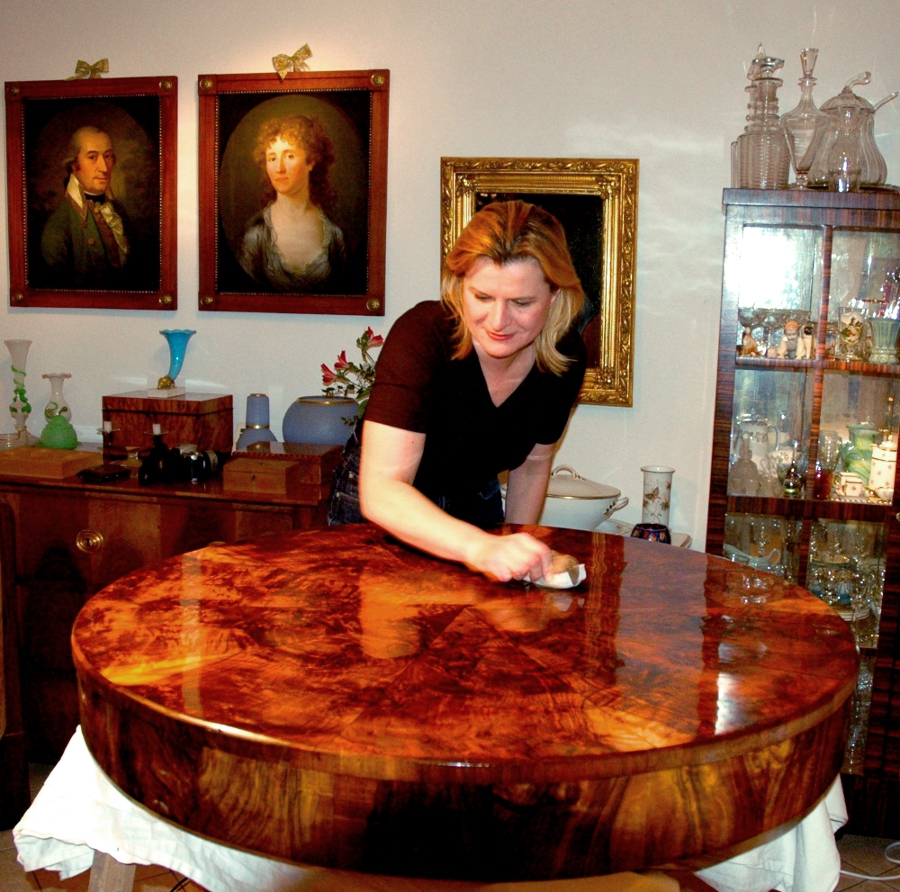
Revive before you replace
Many tired finishes can be revived rather than removed. Cleaning, followed by careful reamalgamation of a shellac finish or a fresh coat compatible with the original, often restores depth without stripping. Reviving keeps the original surface and is, by nature, far less invasive.
A full strip is reserved for finishes that are failing, flaking, or already heavily overcoated by a previous repair. When stripping is unavoidable, it is done as gently as the material allows, with attention to preserving colour and detail in carvings and edges.
How common finishes behave on old wood
- Shellac: a traditional, reversible finish that dissolves in alcohol, which makes it both easy to revive and easy to damage with spills.
- Oil: penetrates the wood and gives a low-sheen, natural look; it is easy to maintain but offers less surface protection.
- Wax: a soft, low-protection top layer often used over other finishes to adjust sheen and feel.
Where the goal is to respect the original piece, finishes that can be removed or reworked later are generally preferred over hard, permanent coatings that lock the surface in.
Colour, sheen, and matching
Old wood is rarely a single uniform tone. Matching a repair to the surrounding surface usually means building colour gradually and checking it in the same light the piece will live in. A sheen that is slightly lower than glass-smooth tends to read as more in keeping with an aged piece.
Curing in a Canadian climate
Finishes cure best within a moderate temperature and humidity range. A cold or very dry workshop can slow or disturb curing, and applying a finish in damp conditions can trap moisture in the film. Letting each coat cure fully before the next, and giving the finished piece time before heavy use, gives a more durable result through seasonal humidity changes.
Keeping the character
The measure of a good refinishing job is that the piece still looks its age. Even wear at the edges, a consistent but not artificial colour, and an appropriate sheen all signal a surface that has been renewed rather than reinvented.
Guidance on finishes and the care of wooden objects is available from the Canadian Conservation Institute and the American Institute for Conservation. Wood behaviour and moisture response are documented by the Forest Products Laboratory.